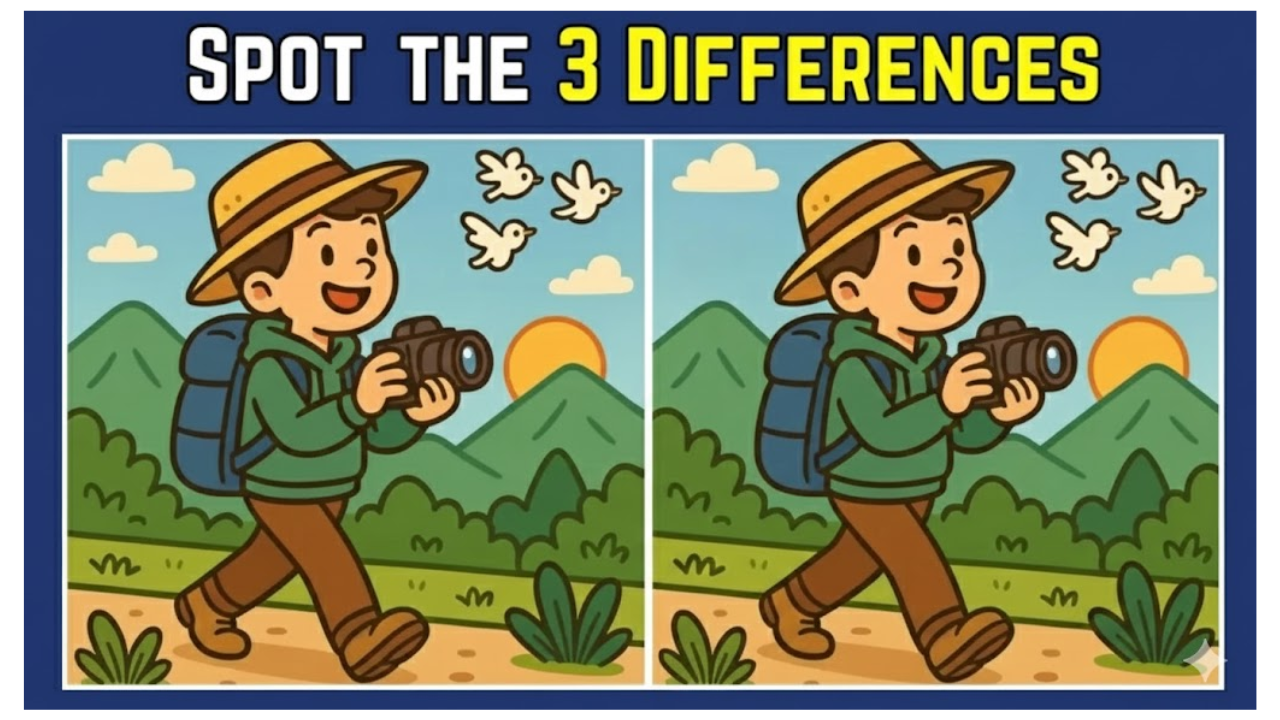
Visual puzzles have a unique way of testing our focus while keeping things entertaining. Among them, Spot the Difference challenges remain especially popular because they appear simple—but quickly prove otherwise. In this 9-second challenge, you’re shown two nearly identical images of a hiker enjoying an outdoor scene. Your task is to find three subtle differences before time runs out.
At first glance, the two pictures look exactly the same. But hidden within the details are small changes that can easily fool the eye. Only careful observation and a calm approach will help you succeed.
Why Spot-the-Difference Puzzles Are So Popular
Spot-the-difference puzzles have stood the test of time because they engage the brain in a unique way. Instead of relying on logic or calculation, they challenge your ability to observe, compare, and notice fine details. These puzzles train the mind to slow down and truly see what’s in front of it.
What makes them especially enjoyable is the balance between simplicity and difficulty. Anyone can try them, but not everyone can solve them quickly. The smallest visual changes—such as missing objects, slight colour shifts, or altered positions—are often the hardest to detect.
How the 9-Second Time Limit Raises the Difficulty
The short time limit adds an extra layer of challenge. With only nine seconds to work, the brain often rushes and overlooks important details. Instead of carefully scanning the image, many people jump from one area to another without fully processing what they see.
Time pressure forces your brain to work faster, sharpening focus but also increasing the chance of mistakes. Those who succeed usually stay calm and follow a structured scanning pattern rather than panicking as the seconds tick away.
Smart Strategies to Spot Differences Quickly
If you want to improve your chances of finding all three differences within the time limit, a methodical approach works best:
Start with the Main Subject
Focus first on the hiker and nearby objects. Large visual changes are often easier to spot before moving to finer details.
Check for Colour Changes
Small shifts in colour—whether in clothing, scenery, or objects—are commonly used tricks in these puzzles.
Examine the Background Carefully
Don’t ignore the surroundings. Differences are often hidden in the background where the eye naturally pays less attention.
Look for Missing or Added Details
Sometimes the key difference is not what’s changed—but what’s no longer there.
Scan in Sections
Divide the image into parts and examine each section one by one. This prevents you from missing subtle changes.
How These Puzzles Improve Brain Function
Solving spot-the-difference puzzles offers more than just entertainment. Regular practice can help improve several cognitive skills:
- Attention to detail, making it easier to notice small changes in daily life
- Visual perception, helping the brain process images more efficiently
- Concentration, especially under time pressure
- Decision-making speed, as you learn to act quickly and accurately
Over time, these benefits can improve how you handle tasks that require focus and observation.
The 3 Hidden Differences Explained
If you weren’t able to find all three differences within nine seconds, here’s a clear breakdown of what changed between the two hiker images:
1. Crocodile in the Water
In one image, a crocodile can be seen in the water behind the hiker. In the other image, the crocodile is completely missing. Because it blends into the background, many people overlook this detail.
2. Bird’s Size and Position
The bird on the left side of the image changes slightly. Its size and placement differ between the two pictures, making it easy to miss unless you focus carefully on the sky area.
3. Missing Finger on the Hiker’s Hand
In one version of the image, the hiker’s hand holding the camera is missing a finger. This subtle change requires close attention to the hiker’s hands, which many viewers scan too quickly.
Why Small Differences Are So Hard to Notice
The human brain is excellent at recognising patterns, but that strength can also become a weakness. When images look nearly identical, the brain assumes consistency and stops actively searching for changes. Under time pressure, this effect becomes even stronger.
Spot-the-difference puzzles take advantage of this tendency, hiding changes in places we expect to remain the same. That’s why patience and a systematic approach are essential.
Long-Term Benefits of Solving Visual Puzzles
Engaging with visual puzzles regularly can help sharpen mental agility over time. These challenges encourage critical thinking, improve focus, and train the brain to remain alert under pressure.
They’re also a great way to relax while still giving your mind a productive workout—making them ideal for short breaks or casual mental exercise.
Conclusion: Ready for Your Next Challenge?
If you managed to find all three differences in under nine seconds, well done—you’ve demonstrated strong observation skills and quick visual processing. If not, don’t be discouraged. These puzzles are designed to challenge perception, not perfection.
With regular practice, your ability to spot differences will improve noticeably. Keep testing your eyes, challenge friends and family, and enjoy the process of sharpening your focus—one puzzle at a time.