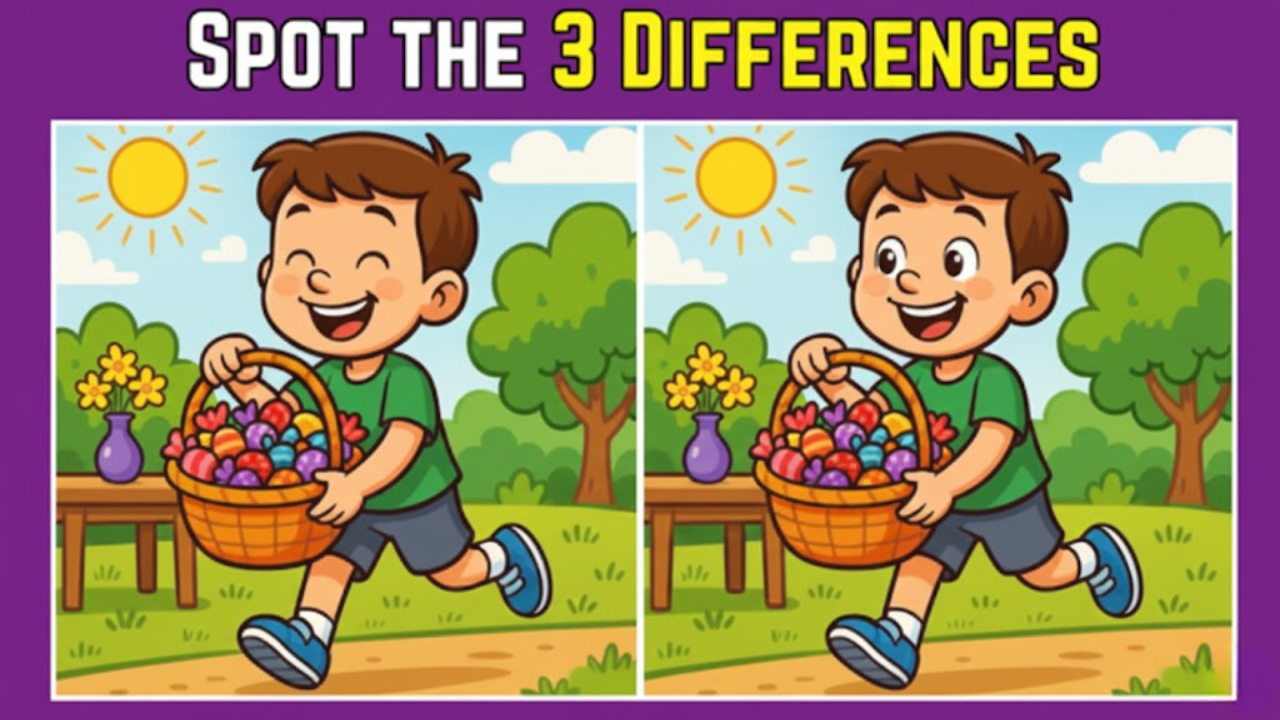
“Spot the 3 Differences” puzzles are among the most loved visual brain games across the world. From children’s activity books to newspapers, mobile apps, and social media challenges, these puzzles test one simple but powerful skill—observation. The image above presents a colorful, cartoon-style scene showing two almost identical pictures of a cheerful boy running with a basket full of fruits in a garden setting. At first glance, both images look exactly the same, but hidden within them are three subtle differences waiting to be discovered.
In this detailed guide, we’ll break down how “Spot the 3 Differences” puzzles work, explain how to approach the image logically, highlight the benefits of playing such puzzles, and share tips to solve them faster—whether you’re a child, parent, teacher, or puzzle lover.
What Is a “Spot the 3 Differences” Puzzle?
A “Spot the 3 Differences” puzzle presents two nearly identical images placed side by side. Your task is to carefully compare both images and identify exactly three changes. These differences may involve:
- Missing or added objects
- Changes in color or shape
- Altered facial expressions
- Swapped positions of elements
- Small background details
The challenge lies in the fact that the differences are often tiny and cleverly hidden, requiring focus and patience.
Understanding the Given Image
The image shown above is designed in a kid-friendly cartoon style, making it engaging and approachable for all age groups.
Scene Overview
- A smiling boy is running happily
- He is carrying a basket filled with fruits
- The background includes trees, bushes, and a sunny sky
- Bright colors create a joyful outdoor atmosphere
At a quick glance, both pictures appear identical—but careful observation reveals three small differences.
How to Spot the 3 Differences in This Image
To solve this puzzle efficiently, follow a structured scanning approach:
1. Start with the Face and Body
Look closely at:
- The boy’s facial expression
- Eyes, smile, eyebrows
- Shoe color or laces
- Hand and leg positions
Facial and body elements are common places for subtle changes.
2. Examine the Basket and Fruits
The basket is filled with fruits of different shapes and colors. Check for:
- A missing or extra fruit
- Color changes
- Different fruit arrangements
These are classic puzzle tricks used to distract the eye.
3. Scan the Background Carefully
Background differences are often the hardest to notice. Look at:
- Trees and leaves
- Flowers or bushes
- The sun, clouds, or sky
- Small objects like pots or plants
A tiny missing leaf or altered object often counts as a difference.
Why “Spot the Differences” Puzzles Are So Popular
These puzzles are not just entertaining—they’re also mentally rewarding.
Key Benefits
- Improves concentration and focus
- Enhances visual perception
- Develops patience and attention to detail
- Great for children’s cognitive development
- Keeps the brain active for adults and seniors
Teachers often use such puzzles in classrooms, while parents rely on them for screen-light, educational fun.
Tips to Solve Spot the Difference Puzzles Faster
If you often get stuck, try these expert tips:
- Divide the image into sections (top, middle, bottom)
- Scan left to right, not randomly
- Don’t rush—slow observation wins
- Compare colors carefully, not just shapes
- Take breaks and look again with fresh eyes
Sometimes, stepping away for a few seconds makes the differences instantly visible when you return.
Who Can Play These Puzzles?
One of the best things about “Spot the 3 Differences” puzzles is that anyone can enjoy them:
- Kids (ages 4+)
- Students
- Parents and families
- Teachers and educators
- Puzzle lovers
- Seniors looking for brain exercises
The difficulty level can be easily adjusted by changing the complexity of the image.
Educational & Entertainment Value
This type of puzzle perfectly balances learning and fun. For children, it builds early observation and reasoning skills. For adults, it offers a relaxing mental break. For seniors, it supports memory and cognitive sharpness.
That’s why such puzzles are widely used in:
- Children’s books
- School worksheets
- Mobile games
- Newspapers and magazines
- Social media engagement posts
Conclusion
The “Spot the 3 Differences” puzzle may look simple, but it’s a powerful exercise for the brain. The colorful image of a happy boy running with a fruit basket is not just visually appealing—it’s cleverly designed to challenge your observation skills. By slowing down, scanning methodically, and paying attention to small details, anyone can enjoy the satisfaction of spotting all three differences.
Whether you’re solving it for fun, learning, or relaxation, these puzzles prove that sometimes the smallest details make the biggest difference.