Brain teaser challenges continue to attract readers who enjoy testing their focus and attention to detail in a short amount of time. Among the most popular formats is the classic spot the difference puzzle. At first glance, these puzzles appear simple—but they often prove far more difficult than expected.
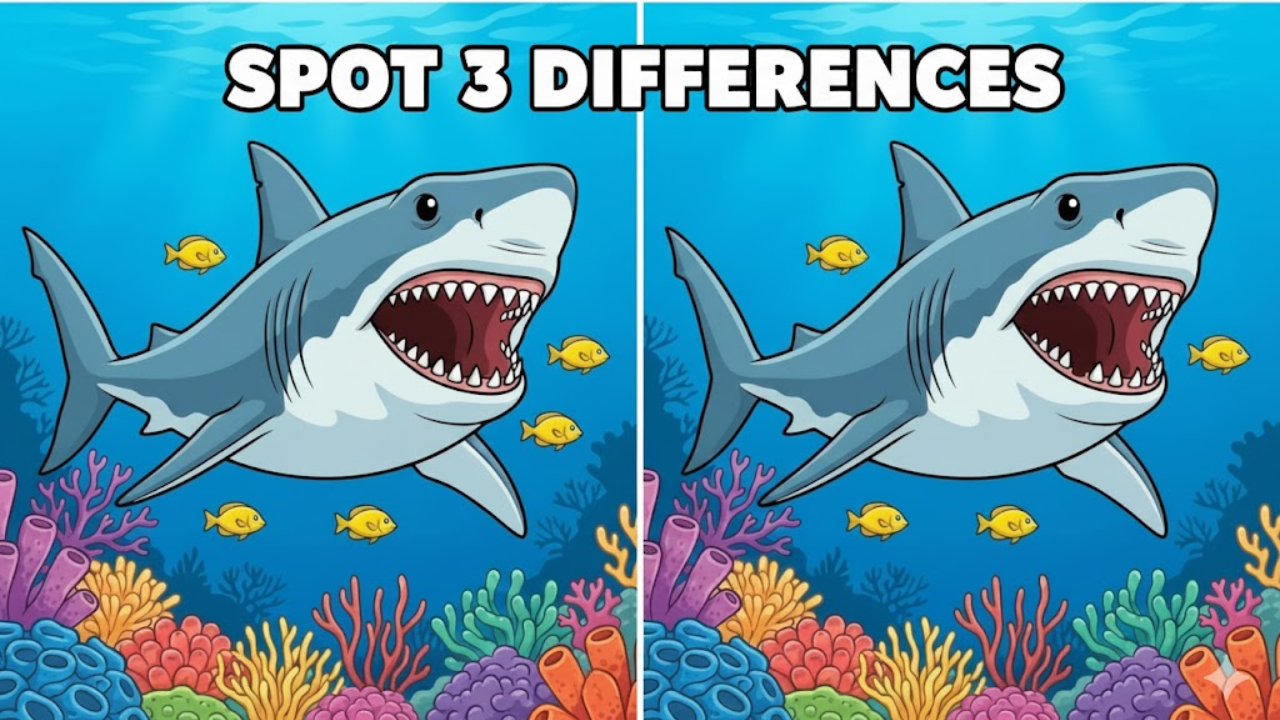
In this visual brain teaser, you are presented with two nearly identical images featuring a shark scene. The task is straightforward: find three hidden differences within just 10 seconds. While the images may look exactly the same at first, subtle changes are cleverly concealed throughout the scene.
Why Spot-the-Difference Puzzles Are So Challenging
Spot-the-difference puzzles work by exploiting how the human brain processes familiar patterns. When two images look nearly identical, the brain quickly assumes there are no changes and stops scanning carefully. This mental shortcut is what makes such puzzles deceptively tricky.
Instead of observing every detail, the mind fills in gaps based on what it expects to see. As a result, small alterations—such as slight color changes or missing objects—are often overlooked, especially under time pressure.
The Impact of the 10-Second Time Limit
Adding a strict time limit significantly increases the difficulty level. When people feel rushed, they tend to scan images randomly rather than following a structured approach. Their eyes jump from one area to another without fully processing what they’re seeing.
Those who succeed usually follow a more methodical strategy. They examine the image section by section—starting with the main subject, then moving to the background, and finally focusing on smaller elements. This organised approach reduces the chances of missing subtle differences.
Common Mistakes People Make
Many participants focus exclusively on the main subject—in this case, the shark—while ignoring the background. However, puzzle designers often hide differences in less obvious areas like scenery or minor objects.
Another common mistake is expecting the differences to be large or dramatic. In reality, these puzzles rely on tiny visual changes, such as:
- Slight color variations
- Objects appearing or disappearing
- Small symbol swaps
Because these changes blend naturally into the image, they’re easy to miss without careful observation.
The Three Hidden Differences Explained
If you managed to find all three differences within the time limit, congratulations—you have strong observation skills. If not, here’s a clear explanation of what changes were made between the two shark images:
First Difference:
In one image, the shark is holding a red box, while in the other image, that box is replaced with a sound icon on the shark’s fin. Because the shape and position are similar, this detail often goes unnoticed.
Second Difference:
One of the palm trees in the background changes between images. In one version, the palm tree has coconuts hanging from it, while in the other, it has only plain leaves. Since this detail appears in the background, many people miss it.
Third Difference:
Near the bottom-right corner of the image, there is a small crab. Its color changes between the two images—red in one and yellow in the other. This is one of the most commonly overlooked differences due to its size.
What This Puzzle Reveals About Your Observation Skills
Spotting all three differences in under 10 seconds suggests strong visual focus, patience, and attention to detail. These skills are valuable not only for puzzles but also for everyday tasks that require careful observation.
If you didn’t find all the differences, don’t worry. These puzzles are designed to challenge perception, not measure intelligence. With practice, anyone can improve their ability to notice fine details more quickly.
How Spot-the-Difference Games Benefit the Brain
Regularly solving visual puzzles like this helps keep the brain active and engaged. These challenges improve:
- Visual memory
- Concentration
- Pattern recognition
- Mental flexibility
Studies in cognitive psychology suggest that visual problem-solving activities help maintain alertness and sharpen observational skills over time.
Tips to Solve Similar Brain Teasers Faster
To improve your performance in future challenges, try these expert-backed strategies:
- Divide the image into sections and scan one area at a time.
- Start with the main subject, then move to the background.
- Look for color changes first, as they’re often easier to spot than shape differences.
- Stay calm and focused—rushing usually leads to missed details.
- Practice regularly, as familiarity improves speed and accuracy.
Final Thoughts
Spot-the-difference brain teasers may look simple, but they’re powerful tools for sharpening your mind. Whether you solve them quickly or take your time, each challenge trains your brain to slow down, observe carefully, and question assumptions.
So the next time you see two images that look “exactly the same,” take a closer look—you might be surprised by what you find.