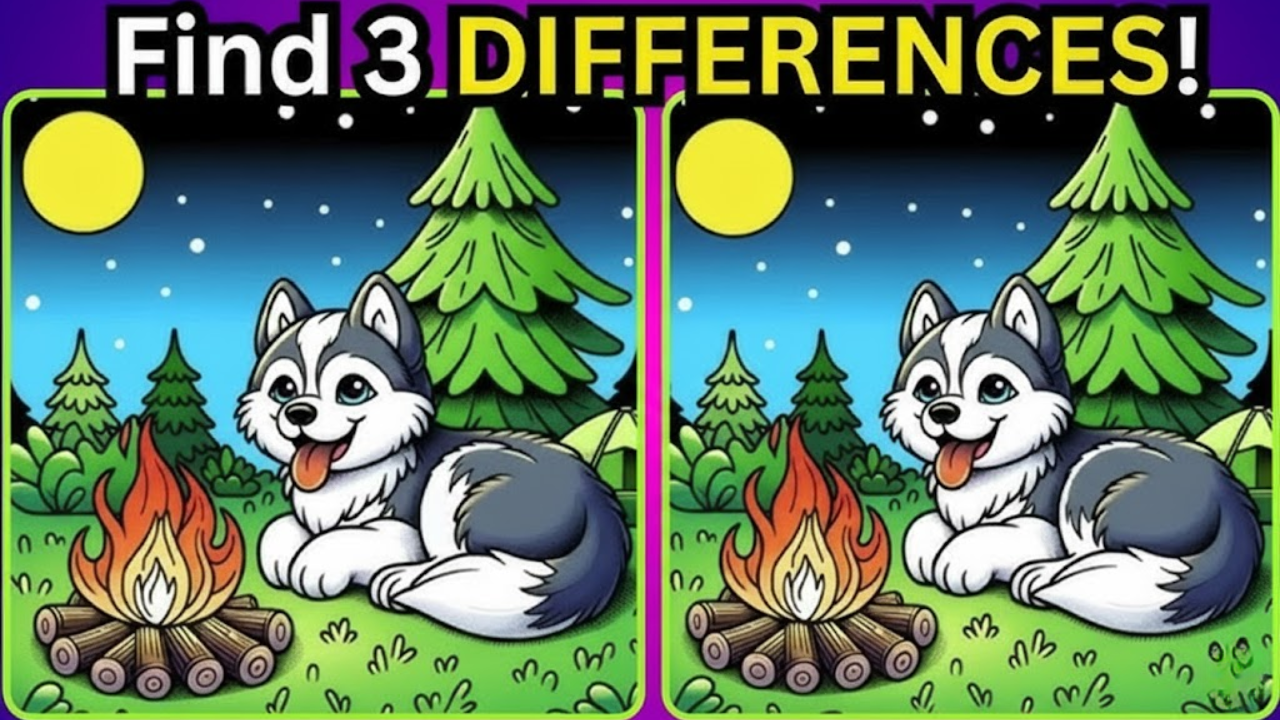
Have you ever stopped scrolling when you saw a “Find the Differences” image—maybe one showing a cute husky sitting beside a glowing campfire under a peaceful night sky—and felt instantly curious? At first glance, both pictures seem exactly the same. But as your eyes linger, tiny details begin to shift, disappear, or change shape.
That moment of discovery is more than simple fun. Spot-the-difference puzzles are powerful mental workouts that sharpen focus, strengthen memory, and offer a rare sense of calm in our fast-paced digital world. Let’s explore why puzzles like the husky campfire scene are so satisfying—and how they quietly improve your brain health.
A Peaceful Scene That Draws You In
The image feels soothing right away: a friendly husky resting near a warm campfire, tall pine trees stretching into a star-filled sky, and a glowing moon lighting the quiet night. Everything feels balanced and calm.
Yet something isn’t quite the same between the two images. Maybe the fire flickers differently. Perhaps a star has vanished, or a tree branch curves another way. These subtle changes invite your mind to slow down and truly look—something we rarely do anymore.
Why Spot-the-Difference Puzzles Are So Addictive
These puzzles have been popular for generations, appearing in newspapers, children’s books, and now social media feeds. Their appeal lies in how perfectly they balance challenge and reward.
Small Wins, Big Satisfaction
Every difference you find triggers a tiny burst of dopamine—the brain’s reward chemical. Each discovery feels like a mini victory.
Just the Right Challenge
They’re not overwhelming, but not effortless either. This balance keeps your brain engaged without causing frustration.
Visual Curiosity
Our brains are wired to detect patterns. When something familiar changes, your attention locks in automatically.
A Sense of Completion
Finding all the differences brings closure and satisfaction—proof that your focus and observation paid off.
How “Find the Differences” Games Boost Brain Power
What looks like a simple visual challenge actually activates multiple cognitive skills at once.
1. Improves Attention to Detail
Your eyes learn to catch small changes in shape, color, and placement—skills that carry over into daily life.
2. Strengthens Visual Memory
Your brain constantly compares one image to the other, training short-term and working memory.
3. Enhances Focus and Patience
You can’t rush these puzzles. They reward steady concentration, much like mindfulness exercises.
4. Sharpens Problem-Solving Skills
Each difference is a tiny puzzle. You analyze, test assumptions, and confirm details—boosting logical thinking.
5. Reduces Stress
The calm visuals and slow pace help quiet mental noise, making these puzzles surprisingly relaxing.
The Husky Campfire Puzzle: A Lesson in Mindful Focus
The husky sitting peacefully by the fire reflects the very state these puzzles encourage—calm awareness. As you scan the flames, trees, and stars, your thoughts slow down. Your attention rests fully in the present moment.
Finding the differences becomes a gentle form of mindfulness, offering clarity and stillness in just a few minutes.
What Science Says About Spotting Differences
Cognitive research shows that visual comparison tasks activate areas of the brain responsible for spatial awareness and pattern recognition. As your eyes move between images, your brain processes color, depth, and structure at a deep level.
Over time, this strengthens neural pathways related to observation and visual discrimination—skills useful in everything from reading to navigating real-world environments.
Smart Strategies to Solve These Puzzles Faster
Want to improve your success rate? Try these simple techniques:
- Scan systematically from one corner instead of jumping around
- Focus on repeating elements like stars, trees, or flames
- Use peripheral vision—differences often “pop out” unexpectedly
- Take short breaks to refresh your eyes
- Compare shading and brightness, not just shapes
Hints for the 3 Hidden Differences in the Husky Puzzle
Without giving everything away, here’s where to look:
- The campfire flames may change in height or shape
- The moon’s glow or position could be slightly different
- A tree branch or star might be missing or altered
Each discovery brings that satisfying “aha!” moment.
Perfect for Every Age Group
Spot-the-difference puzzles are universally appealing.
- Children develop focus and visual coordination
- Adults keep their minds sharp and engaged
- Seniors benefit from mental stimulation that supports cognitive health
That’s why educators, parents, and caregivers love these games—they feel like play, but deliver real benefits.
Noticing More Than Just Pictures
As you train your eyes with visual puzzles, something interesting happens—you begin noticing more in everyday life. Small details stand out. Moments feel richer. Awareness grows.
Just as you observe tiny changes in a husky campfire scene, you start appreciating the subtle beauty in daily experiences.
Final Thoughts: Finding Calm in the Details
A simple “Find the 3 Differences” puzzle may seem like light entertainment, but it offers much more. It invites you to slow down, sharpen your mind, and reconnect with the joy of focused attention.
So next time a spot-the-difference image crosses your screen, pause for a moment. Look closely. Enjoy the process. You might find that the real reward isn’t just spotting the differences—but discovering how peaceful paying attention can be.